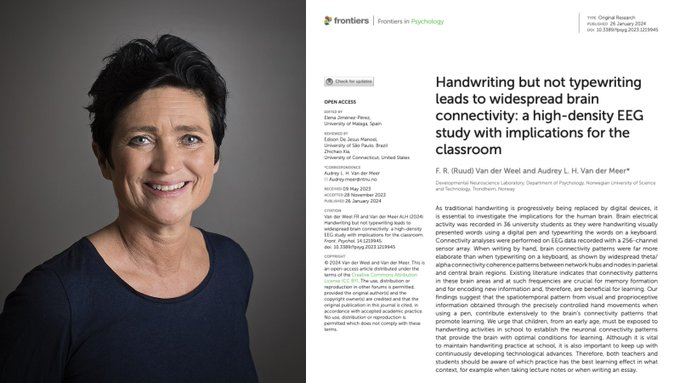
一位挪威神经科学家花了20年时间证明,手写行为以打字无法比拟的方式改变了人类大脑,而她领域之外几乎没人读过那篇论文。
她的名字是奥黛丽·范德米尔(Audrey van der Meer)。
她在特隆赫姆经营着一个大脑研究实验室,而那篇终结争论的论文于2024年发表在《心理学前沿》(Frontiers in Psychology)期刊上。这一发现残酷到足以改变地球上每一个教室。
实验很简单。她招募了36名大学生,让每个人戴上一个带有256个传感器紧贴头皮的帽子供记录大脑活动。单词一个接一个地在屏幕上闪现。
有时学生们用数字笔在触摸屏上手写单词,有时他们在键盘上打出相同的单词。每个神经反应都被记录下来,持续整个单词在屏幕上停留的五秒钟。
然后她的团队查看了多年来大多数研究者忽略的数据部分,即任务过程中大脑不同区域之间如何相互沟通。
当学生们手写时,大脑各处同时亮起。
负责记忆、感官整合和新信息编码的区域以一种协调模式一起激活,这种模式扩散到整个皮层。整个网络都苏醒并连接起来。
当同样的学生们打出相同的单词时,这种模式几乎完全崩溃。
大脑大部分区域变得安静,秒钟前还活跃的区域间连接在脑电图上完全消失。
相同的单词,相同的大脑,相同的人,却发生了两种完全不同的神经事件。
原因原来是之前没人真正注意过的东西。手写不是一个动作,而是成千上万细微微运动的序列,与你的眼睛实时协调,每一个字母都是不同的形状,需要大脑解决略微不同的空间问题。
你的手指、手腕、视觉,以及大脑中追踪空间位置的部分,都在共同协作产生一个字母,然后下一个,再下一个。
打字则把这一切都扔掉了。键盘上的每个键无论按哪个字母,都需要完全相同的手指动作,这意味着大脑几乎没什么需要整合的,也几乎没什么问题需要解决。
范德米尔在她的访谈中直白地说了出来。
反复用同一根手指按同一个键并不能以任何有意义的方式刺激大脑,她还指出了一件应该让每个给孩子iPad的父母感到害怕的事。
那些在平板电脑上学习阅读和写作的孩子往往无法区分b和d这样的字母,因为他们从未用身体亲身感受到在纸上真正产生这些字母需要什么。
在她之前十年,普林斯顿大学的两位研究者用一种完全不同的方法进行了同样的战斗,最终得出了相同的答案。帕姆·穆勒(Pam Mueller)和丹尼尔·奥本海默(Daniel Oppenheimer)测试了327名学生,进行了三项实验,其中一半学生在禁用互联网的笔记本电脑上做笔记,另一半用手写笔记,然后测试每个人对他们观看的讲座真正理解了什么。
手写组在每一个需要真正理解而非表面回忆的问题上都以较大优势获胜。
原因隐藏在两组实际写下的内容记录中。
笔记本电脑组的学生几乎一字不差地打字,捕捉了更多总内容,但几乎没有处理任何内容,而手写组的学生物理上无法写得足够快来实时转录讲座,这迫使他们仔细倾听,决定什么真正重要,并用自己的话写在纸上。
这种选择保留什么的单一行为本身就是学习,而键盘悄无声息地跳过了选择,也随之跳过了学习。
两项研究。两个国家。相同的答案。
手写让大脑工作。打字让它滑行。
你曾经打字而不是手写的每一条笔记,都通过一根更细的管道进入你的大脑。每一次会议、每一段书中的高亮、每个你用手机而不是纸张捕捉的想法,都只被处理到一半深度。
你不是因为记忆力差而忘记那些东西。你忘记它们是因为打字从未唤醒大脑中会让它们记住的部分。
解决办法是你祖母早已知道的东西。
拿起一支笔。把事情写下来。较慢的路才是更快的路。
A Norwegian neuroscientist spent 20 years proving that the act of writing by hand changes the human brain in ways typing physically cannot, and almost nobody outside her field has read the paper.
Her name is Audrey van der Meer.
She runs a brain research lab in Trondheim, and the paper that closed the argument was published in 2024 in a journal called Frontiers in Psychology. The finding is brutal enough that it should have changed everyroom on Earth.
The experiment was simple. She recruited 36 university students and put each one in a cap with 256 sensors pressed against their scalp to record brain activity. Words flashed on a screen one at a time.
Sometimes the students wrote the word by hand on a touchscreen using a digital pen, and sometimes they typed the same word on a keyboard. Every neural response was recorded for the full five seconds the word stayed on screen.
Then her team looked at the part of the data most researchers had ignored for years, which is how different parts of the brain were communicating with each other during the task.
When the students wrote by hand, the brain lit up everywhere at once.
The regions responsible for memory, sensory integration, and the encoding of new information were all firing together in a coordinated pattern that spread across the entire cortex. The whole network was awake and connected.
When the same students typed the same word, that pattern collapsed almost completely.
Most of the brain went quiet, and the connections between regions that had been alive seconds earlier were nowhere to be found on the EEG.
Same word, same brain, same person, and two completely different neurological events.
The reason turned out to be something nobody had really paid attention to before her work. Writing by hand is not one motion but a sequence of thousands of tiny micro-movements coordinated with your eyes in real time, where each letter is a different shape that requires the brain to solve a slightly different spatial problem.
Your fingers, wrist, vision, and the parts of your brain that track position in space are all working together to produce one letter, then the next, then the next.
Typing throws all of that away. Every key on a keyboard requires the exact same finger motion regardless of which letter you are pressing, which means the brain has almost nothing to integrate and almost no problem to solve.
Van der Meer said it plainly in her interviews.
Pressing the same key with the same finger over and over does not stimulate the brain in any meaningful way, and she pointed out something that should scare every parent who handed their kid an iPad.
Children who learn to read and write on tablets often cannot tell letters like b and d apart, because they have never physically felt with their bodies what it takes to actually produce those letters on a page.
A decade before her, two researchers at Princeton ran the same fight using a completely different method and ended up at the same answer. Pam Mueller and Daniel Oppenheimer tested 327 students across three experiments, where half took notes on laptops with the internet disabled and half took notes by hand, before testing everyone on what they actually understood from the lectures they had watched.
The handwriting group won by a wide margin on every question that required real understanding rather than surface recall.
The reason was hiding in the transcripts of what the two groups had actually written down.
The laptop students typed almost word for word, capturing more total content but processing almost none of it as they went, while the handwriting students physically could not write fast enough to transcribe a lecture in real time, which forced them to listen carefully, decide what actually mattered, and put it in their own words on the page.
That single act of choosing what to keep was the learning itself, and the keyboard had quietly skipped the choosing and skipped the learning along with it.
Two studies. Two countries. Same answer.
Handwriting makes the brain work. Typing lets it coast.
Every note you have ever typed instead of written went into your brain through a thinner pipe. Every meeting, every book highlight, every idea you captured on your phone instead of on paper was processed at half depth.
You did not forget those things because your memory is bad. You forgot them because typing never woke the part of the brain that would have made them stick.
The fix is the thing your grandmother already knew.
Pick up a pen. Write the thing down. The slower road is the faster one.